A north-facing wall can feel like the awkward corner of a garden: cool, sunless for much of the day and hard to dress. Yet several clematis flower well there, and some look better for it, because their colours hold instead of bleaching in hot sun.
What "shade" really means for clematis
Not all shade is equal. A north wall in an open garden receives bright, indirect light all day, and often a little early or late sun in midsummer. The RHS notes that very shady positions give poor flowering, and that the top of the plant should not be in deep shade.
Light shade or deep shade?
| Open north wall | Deep shade | |
|---|---|---|
| Light | Bright, indirect, all day | Dense trees or tall buildings |
| Flowering | Good; colours hold | Poor |
| Verdict | Plant here | Avoid |
In other ways a north wall suits clematis well, keeping the root zone cool and moist. The British Clematis Society even suggests planting on the north, rainier side of trees and shrubs.
Why large-flowered hybrids can shine in shade
The RHS observes that twice-flowering clematis, the large-flowered hybrids of pruning group 2, suit shadier positions because shade slows the fading of flower colour. Pale pinks, mauves and striped flowers that wash out on a hot south wall keep their markings on a north or east wall.
Clematis that tolerate north-facing positions
All of the following are listed in the RHS plant database as suitable for a north-facing aspect.
When shade-tolerant clematis flower
'Nelly Moser' (group 2)
The classic choice: rosy-lilac flowers up to 20cm across, each sepal marked with a carmine stripe. The RHS rates it H6 and AGM, and notes that its colour fades in strong sun. It is also listed as susceptible to clematis wilt.
'Hagley Hybrid' (group 3, or group 2/3)
Shell-pink flowers with deep red anthers. The RHS lists north, east and west aspects and says it is best in part shade to preserve its colour.
'Ooh La La' (Boulevard series, group 2)
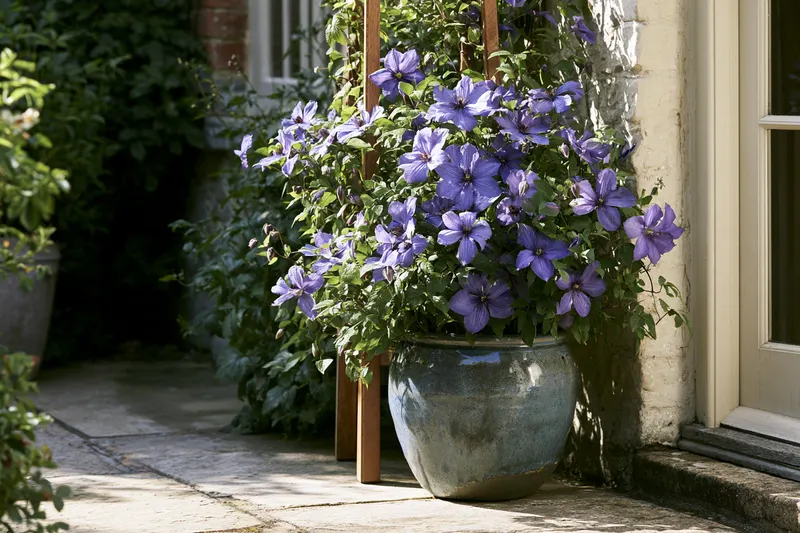
A compact plant for partial or full shade, best in partial shade to stop the flowers fading. Good for a shady courtyard or a pot by a north-facing door.
'Frances Rivis' (group 1)
A tough alpina-type with nodding, violet-blue spring flowers, rated H6 and AGM. Alpina types are on the RHS list of wilt-resistant clematis and need very little pruning.
'Piilu' (group 2)
Pale pink with a darker central bar, double or semi-double in its first flush and usually single later. It grows to 1.5–2.5m.
'Étoile Violette' and 'Perle d'Azur' (group 3)
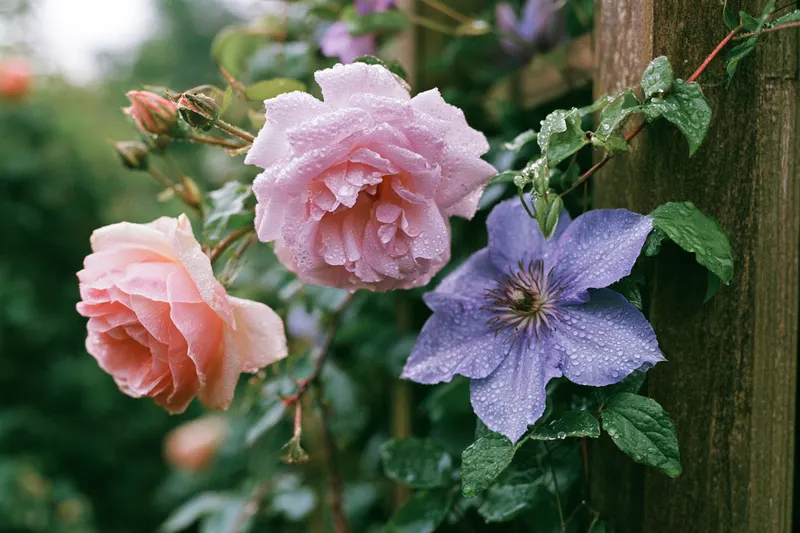
Two robust, AGM late-flowerers for full sun or partial shade: deep purple 'Étoile Violette' and clear pale blue 'Perle d'Azur'. Give them the brightest stretch of wall, perhaps with a shade-tolerant climbing rose (see combining clematis with roses).
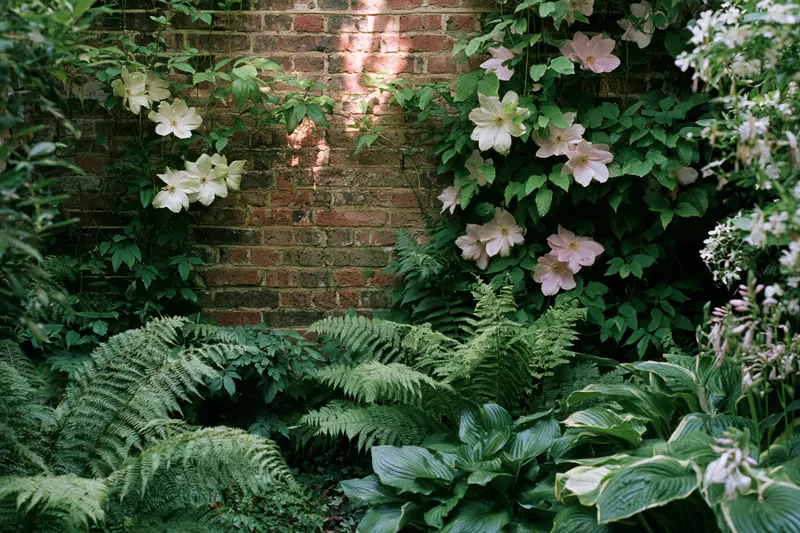
On the darkest walls, pale and white flowers show up far better than deep purples and reds. Lighter shades such as 'Nelly Moser', 'Hagley Hybrid' or 'Perle d'Azur' make the most of limited light.
Plants to treat with caution
Getting the best from a north wall
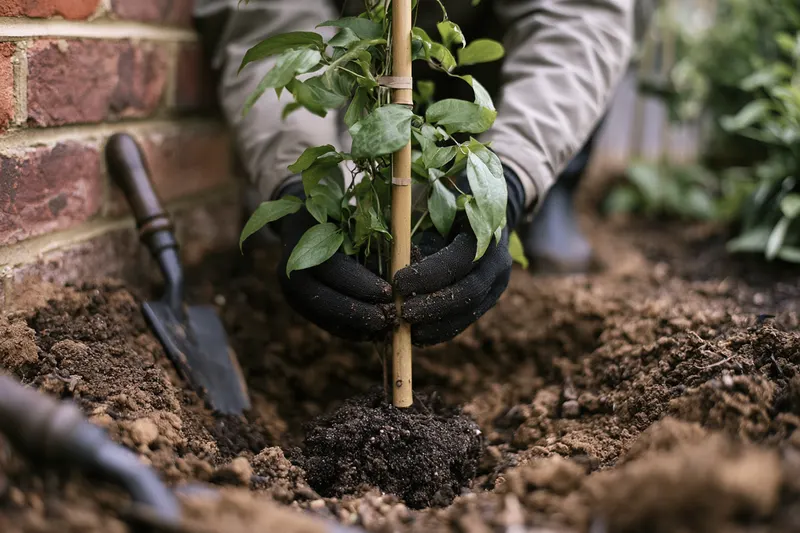
Even a shady wall stays dry at its base, and cool, damp beds suit slugs and snails. Improve the soil with organic matter and plant at the right depth for the type: our guide to planting a clematis has the details.
North-wall checklist
- Planted 30–45cm out of the rain shadow
- Stems led to the support on a cane
- Trellis on battens, 2.5cm off the wall
- Pale-painted wall to reflect light
- Planting hole that drains in winter
- Slug protection for new spring shoots
Be patient: growth in shade is usually slower, and flowering may start a little later than on a sunny wall.
East-facing walls
East walls get morning sun and afternoon shade, and all the clematis above are also rated by the RHS for east-facing positions. In much of Britain, east-facing sites catch cold winter winds, so evergreen clematis are still happier on a sheltered south or west wall.
North walls suit clematis whose colours fade in sun, such as 'Nelly Moser', 'Hagley Hybrid' and Boulevard types, plus tough choices like 'Frances Rivis', 'Étoile Violette' and 'Perle d'Azur'. Avoid deep shade, plant 30–45cm from the wall and keep evergreen types for sheltered, sunnier spots.
Our sources
- Clematis for shady walls (RHS) — Notes that twice-flowering clematis suit shade because shade slows colour fading.
- Clematis 'Nelly Moser' (RHS Plants) — All aspects, H6, AGM, group 2; flower colour fades in strong sun.
- Clematis 'Hagley Hybrid' (RHS Plants) — North, east and west aspects; best in part shade to preserve flower colour.
- Clematis problems: frequently asked questions (RHS) — Poor flowering when the top of the plant is in deep shade; roots should be cool and shaded.
- Clematis 'Étoile Violette' (RHS Plants) — Flowers mid to late summer, 2.5–4m, any aspect, H6, AGM, group 3.
- Clematis pruning: group three (RHS) — 'Perle d'Azur' and 'Hagley Hybrid' as mid- to late summer clematis that can be pruned as group 2 or 3.
- Clematis Ooh La La ('Evipo041') Boulevard Series (RHS Plants) — Flowers late spring to late summer; height 1–1.5m; best in partial shade.