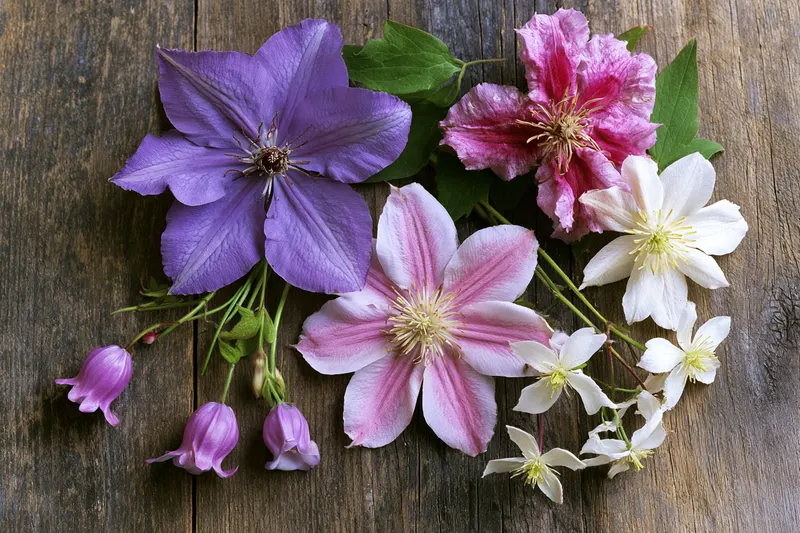
Clematis fall into four main groups: winter and spring-flowering types (evergreens, alpinas, montanas), early-summer large-flowered hybrids, summer and autumn-flowering types, and non-climbing herbaceous clematis. The group tells you when a plant flowers, how big it grows and how to prune it.
The RHS sorts garden clematis by flowering season, plus a separate group of non-climbing herbaceous types. That is the framework used here.
The four main types at a glance
| Winter & spring | Early large-flowered | Summer & autumn | Herbaceous | |
|---|---|---|---|---|
| Flowers | Mid-winter to late spring | Late spring–early summer, often again later | From late June | Early summer to autumn |
| Pruning group | 1 | 2 | 3 | 3 |
| Typical height | 1.5–12m | 1.5–2.5m | About 3m, some to 8m | 75cm–1.5m |
| Examples | Cirrhosa, alpina, montana | 'Nelly Moser', 'Niobe' | 'Jackmanii', viticellas | C. integrifolia |
What are winter and spring-flowering clematis?
Winter and spring-flowering clematis flower from mid-winter to late spring on growth made the previous year, so they belong to pruning group 1 and need little routine pruning.
Evergreens
C. cirrhosa and C. armandii keep their leaves and flower in winter or early spring. They are less hardy than other types and need a sunny, sheltered spot; see our guide to evergreen and winter-flowering clematis.
Alpinas and macropetalas
Compact, tough plants with nodding spring flowers. 'Frances Rivis' and C. macropetala 'Wesselton' reach 1.5–2.5m, and the alpina types in the RHS award list are rated H6, hardy throughout the UK.
Montanas
The giants of the genus. The RHS warns that C. montana can exceed 8m unless pruned, and 'Elizabeth' is listed at 8–12m, so give them a large wall, shed roof or tree.
What are large-flowered hybrid clematis?
This is the classic big-flowered clematis. The main display of large, star-shaped flowers comes in late spring and early summer, and many repeat in late summer with smaller flowers. Most popular cultivars, such as 'Nelly Moser', 'The President' and 'Niobe', reach 1.5–2.5m.
They are pruning group 2. Double forms usually do best in sun, and the RHS advises planting them with the top of the rootball 5–7.5cm below the soil surface. Clematis wilt mainly affects these large-flowered hybrids.
Which clematis flower in summer and autumn?
Summer and autumn-flowering clematis all flower from late June onwards on the current year's growth, so they are cut back hard in late winter (group 3). The group is varied:
- Late large-flowered hybrids such as 'Jackmanii' and 'Comtesse de Bouchaud', typically about 3m.
- Viticella and texensis types, with smaller bell- or tulip-shaped flowers on plants up to 4m, such as 'Étoile Violette' and 'Princess Diana'.
- C. flammula and C. rehderiana, grown for clouds of small, fragrant flowers.
- C. tangutica types such as 'Bill MacKenzie' (4–8m), valued for silky autumn seedheads.
Height of typical examples
What are herbaceous clematis?
Herbaceous clematis don't climb. They grow from the ground each spring and die back in autumn, and the RHS says most reach 75cm–1.5m. Their stems are floppy, so give them a support or let them lean into a low shrub. They need full sun to flower well.
Flowering season by type
How do you choose a clematis?
Begin with the space. The British Clematis Society notes that clematis range from under 1m to over 10m, depending on type and growing conditions, so check the label height against your support. Compact types also suit growing in containers.
Then think about the season you want to fill and how much pruning you are prepared to do. Group 1 needs the least, group 3 the simplest routine, and group 2 a little more judgement; our guide to clematis pruning groups explains each one.
Questions to ask before buying
- Which season do I want flowers?
- How tall is my support?
- Sun, part shade or shade?
- In the ground or in a pot?
- How much pruning will I do?
- Is my garden cold or exposed?
Questions we get asked
Which clematis is easiest to prune?
Group 3, the summer and autumn-flowering types, have the simplest routine: cut them back hard in late winter. Group 1 needs the least pruning, group 2 a little more judgement.
How big do clematis grow?
From under 1m to over 10m, says the British Clematis Society. Montanas can exceed 8m, while most large-flowered hybrids reach 1.5–2.5m.
Which clematis are the hardiest?
The alpina types on the RHS award list are rated H6, hardy throughout the UK. Evergreens are the least hardy and need a sunny, sheltered spot.
Which clematis get clematis wilt?
Mainly the early-summer large-flowered hybrids, such as 'Nelly Moser' or 'The President'.
Pick the group first: spring flowerers for early colour with little pruning, large-flowered hybrids for showy blooms, late-summer types for easy pruning and long seasons, and herbaceous clematis for borders.
Our sources
- How to grow clematis (RHS) — Flowering-season types, herbaceous heights of 75cm–1.5m, pruning group timing and planting depth for large-flowered hybrids.
- Winter & spring flowering clematis (RHS) — Mid-winter to late spring flowering, heights of alpinas, macropetalas and montanas, shelter for evergreens.
- Early-summer-flowering clematis (RHS) — Main display in late spring and early summer, repeat flowering, heights of popular large-flowered cultivars.
- Summer & autumn flowering clematis (RHS) — Late large-flowered hybrids, viticella, texensis, flammula, rehderiana and tangutica types with heights.
- Herbaceous clematis (RHS) — Non-climbing habit, support, full sun and heights of herbaceous species.
- Growing (British Clematis Society) — Climbers, scramblers and herbaceous types; heights from under 1m to over 10m.